
In recent times it has felt as though almost every year has brought a crisis
COVID, soaring inflation, sharp interest-rate rises, the war in Ukraine, trade tensions, fears of AI disruption, conflict in Iran, and surging energy prices, to name just a few.
Each time, negative headlines have fuelled concern and given people plenty of reasons to stay on the sidelines and wait for things to calm. History shows, however, that investors are rarely rewarded for waiting until uncertainty disappears. Uncertainty never disappears; it simply changes shape. As one concern fades, another emerges.
Over the past quarter-century, investors have faced the dotcom crash, terrorist attacks, wars, deep recessions, banking failures, sovereign debt crises, a pandemic, inflation shocks, aggressive central bank tightening, trade wars, and many other disconcerting events. In every case, uncertainty felt acute and caution seemed sensible.
Our instincts tell us to ‘play it safe’
That instinct is understandable. Watching markets fall is unsettling, and when bad news dominates the headlines, it can feel much safer to sit in cash and wait for things to settle. Part of the reason is something psychologists call negativity bias — people’s tendency to give more weight to threats than to opportunities.
Thousands of years ago, that bias was useful. If our ancestors heard a noise in the bushes, it paid to assume danger first and ask questions later. The cost of overreacting was small; the cost of underreacting could be fatal. We are wired to pay close attention to what might go wrong.
But while that instinct helped humans survive when we were living on the savannah, it can work against us when investing. Financial markets are never short of reasons to worry. A looming recession, a war, or a political shock can feel like compelling reasons to wait. The danger is that an investor becomes so focused on avoiding short-term pain that they lose sight of the potential cost of staying on the sidelines.
No such thing as the perfect moment to invest
For long-term investors, the better approach is usually not to wait for the perfect moment, but to remember what they are investing for: not the next few weeks or months, but the years ahead. Unfortunately, volatility is part of investing. We never know exactly when it will arrive, but we do know it will come, and it will always feel uncomfortable when it does. That discomfort is the price paid for earning higher long-term returns compared with more stable options such as cash or bank deposits.
This does not mean ignoring risk. It means managing risk properly. A sound portfolio should be built around a time horizon that suits your goals, a level of risk you are comfortable with, adequate access to funds if required, and diversification across asset classes, countries, and sectors. Most importantly, it should be built to help investors stay the course through the inevitable bouts of market volatility, rather than panic and turn a temporary pullback into a permanent loss.
History provides useful perspective. Looking back, it is remarkable how many years seemed to offer compelling reasons not to invest. In some cases, markets did fall sharply. But the bigger mistake was often waiting, assuming that a clear and comfortable entry point was just around the corner. It rarely is.
Markets climb a wall of constant worry
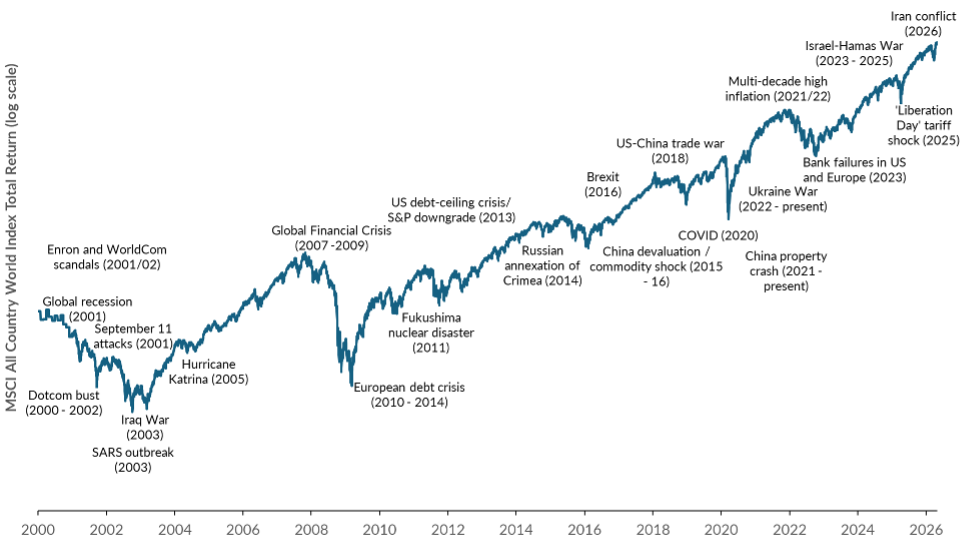
Source: LSEG, Forsyth Barr analysis
If at any time you want to discuss investment options and opportunities, a Forsyth Barr Investment Adviser is available to provide advice and assistance. Call 0800 367 227 or visit forsythbarr.co.nz.
Reasons Not to Invest — A History
- 2000 — Dotcom bubble bursts.
- 2001 — Global recession. September 11 terror attacks. Enron scandal. Ansett and HIH Insurance collapse in Australia. Argentina defaults on its debt.
- 2002 — WorldCom bankruptcy and accounting scandal. Tech stocks continue to fall.
- 2003 — ‘War on Terror’. Iraq war. SARS disrupts travel. Deflation fears.
- 2004 — Oil-price shock. US interest-rate rises.
- 2005 — Hurricane Katrina disrupts refineries and pushes up energy prices. Concerns about an overheated New Zealand housing market.
- 2006 — US interest-rate hikes. The US housing bubble begins to unravel. First New Zealand finance company collapses.
- 2007 — BNP Paribas freezes three subprime funds. Northern Rock bank run. Credit markets seize up. New Zealand finance company failures spread.
- 2008 — Global Financial Crisis. Fannie Mae and Freddie Mac placed into conservatorship. Lehman Brothers collapses. Major bank bailouts.
- 2009 — Deep global recession. Icelandic bank defaults. Dubai debt crisis.
- 2010 — Greece and euro-area sovereign debt crisis. May ‘flash crash’. First major Christchurch earthquake. South Canterbury Finance goes into receivership.
- 2011 — Euro crisis intensifies. US sovereign debt downgrade. Fukushima nuclear disaster. Arab Spring. Second Christchurch earthquake.
- 2012 — Fears of Grexit and a euro-area break-up. US fiscal cliff.
- 2013 — US taper tantrum. US government shutdown. Cyprus banking crisis.
- 2014 — Negative interest rates in Europe. Russia annexes Crimea. Ebola outbreak. Dairy prices slump.
- 2015 — China slowdown fears, yuan devaluation, and collapsing commodity prices. US Fed starts hiking rates. Greece default fears.
- 2016 — Brexit. US election uncertainty. Kaikōura earthquake.
- 2017 — US quantitative tightening. North Korea tensions.
- 2018 — US-China trade war. Tightening monetary policy.
- 2019 — Escalation in the US-China trade war. Inverted yield curve raises recession fears.
- 2020 — COVID-19 shutdowns. Borders close. Deepest recession since the Great Depression.
- 2021 — Surging inflation. Supply-chain disruption. New COVID variants. Evergrande debt default and the start of China’s property crisis. New Zealand border remains closed.
- 2022 — Russia invades Ukraine. Energy shock. FTX and crypto collapse. New Zealand inflation hits 7.3%. Aggressive central bank interest rate hikes. New Zealand house prices fall sharply.
- 2023 — Weak Chinese economy. Failures of Silicon Valley Bank and Credit Suisse spark fears of banking contagion. New Zealand recession. Auckland floods and Cyclone Gabrielle.
- 2024 — Concerns about higher-for-longer interest rates. US election uncertainty. AI disruption fears. Israel-Hamas war and Red Sea shipping disruption.
- 2025 — Trump tariff volatility. AI bubble fears. DeepSeek shock.
- 2026 — Ongoing AI uncertainty. Conflict in Iran. Energy-price pressure.
Copyright Forsyth Barr Limited. You may not redistribute, copy, revise, amend, create a derivative work from, extract data from, or otherwise commercially exploit this publication in any way. This publication has been prepared in good faith based on information obtained from sources believed to be reliable and accurate. This publication does not contain financial advice - for financial advice, please speak to a Forsyth Barr Investment Adviser.


