
A Bridge to a Billion Consumers
On 22 December 2025, New Zealand concluded negotiations on a free trade agreement (FTA) with India. The FTA did not dominate headlines in the way some trade deals do.
There were no immediate step-changes in dairy access, and no overnight surges in export volumes, but that understates the possible significance of what has been achieved.
India has historically been a difficult market to enter given strong protectionist policies for local industries. Initial trade conversations commenced back in 2010, when India was identified as a priority country by New Zealand. Tariffs have been high across categories, particularly for agricultural and food products, where New Zealand is naturally competitive. While New Zealand exporters have been active in India, tariffs have acted as a brake on competitiveness, scale, and long-term investment. This is changing. India has been actively concluding FTAs — six in the last five years — suggesting momentum towards deeper trade integration with trusted partners.
The FTA eliminates or reduces tariffs on 95% of New Zealand’s exports, with more than half becoming duty-free immediately and most of the remainder phased out over the following decade. Not only does the FTA improve the economics of exporting to India; more importantly, it creates confidence. Exporters will be more willing to invest in market development, branding, distribution, and capacity once access is more secure and predictable.
We see the big prize not as a one-off lift in exports or margins but rather access to a vast, developing market where demand is likely to rise for decades.
THE FTA COVERS A WIDE RANGE OF KEY EXPORTS, WITH BENEFITS VARYING BY SECTOR
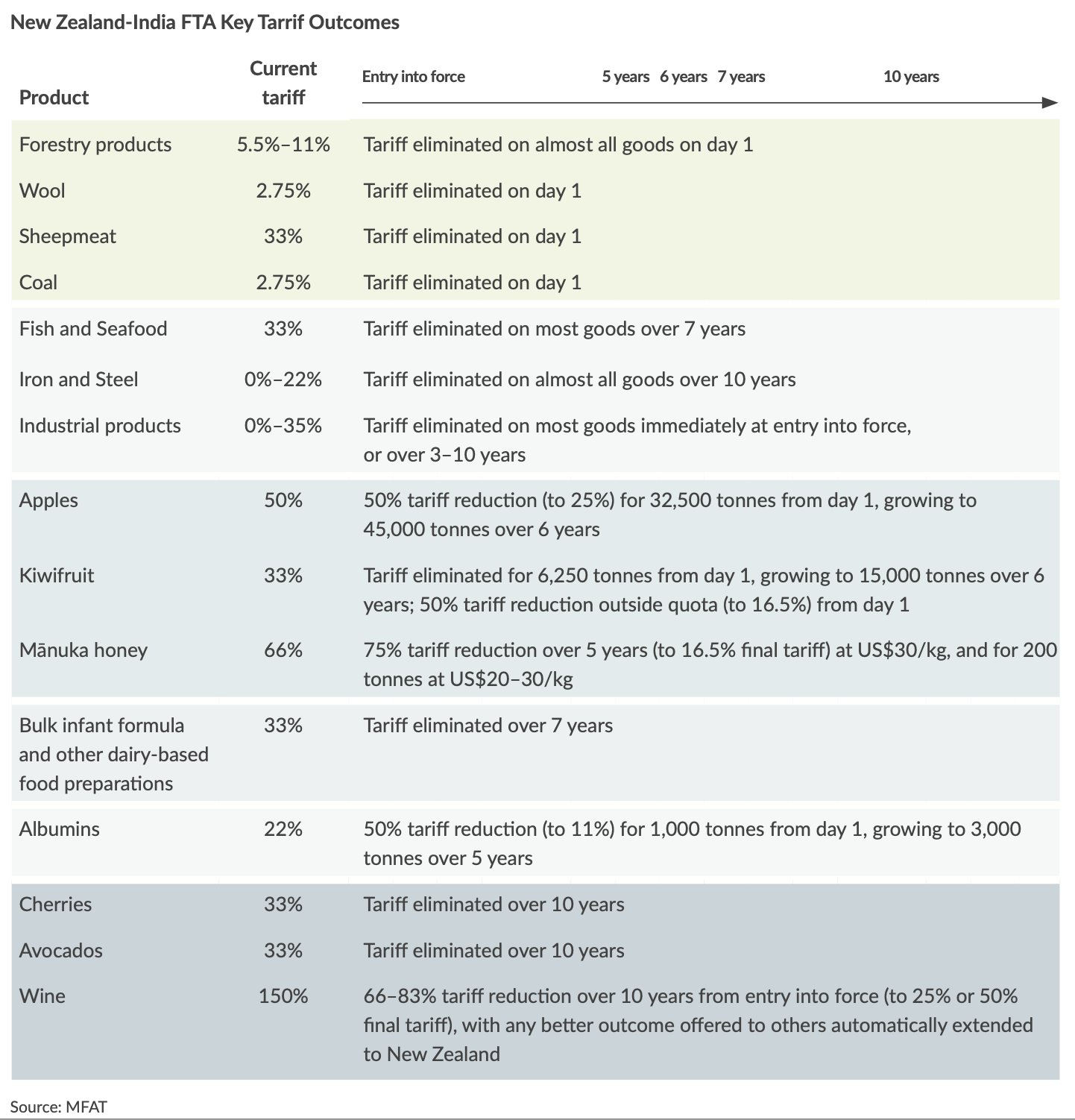
Why India matters
India is the fifth-largest economy globally and the fastest-growing within the G20 (a group of major economies). By 2030 it is expected to become the world’s third-largest economy with a GDP of around US$7 trillion. India’s population is close to 1.5 billion; it overtook China as the world’s most populous country in 2022, and now records around 24 million births annually versus roughly 8 million in China. Growth has been a feature over the past decade: (1) GDP has grown at around 7% per annum; (2) household consumption has increased at a similar rate; while (3) income per capita has expanded by about 6% a year. While growth has been strong, it is important to recognise that India is still a developing nation. Its GDP per capita ranks 166th globally and sits approximately where China was in 2007 (its total GDP is around 20% of China’s) and New Zealand in the early 1970s—but herein lies the opportunity.
A growing middle class
By 2030, India is expected to have a middle class of more than 700 million; by 2046, this is expected to exceed 1 billion, up from about 430 million in 2020. As a percentage of the population, the middle and wealthy classes are expected to grow from 34% today to 87% by 2046. While in 2022 it was estimated that only 56% of individuals use the internet, this is up sharply from around 17% in 2016.
Middle-class households typically have enough money to satisfy their primary needs — with some disposable income left over for additional consumption and savings. History provides a clear lesson: as incomes rise, consumption patterns change rapidly. This transition does not happen overnight, but it is powerful and persistent. China’s experience over the past two decades illustrates how quickly a developing economy can become a major destination for premium imports once incomes reach a certain threshold.
Spending shifts away from necessities and towards:
- Higher-quality food and protein
- Branded consumer goods
- Travel and tourism
- Education and digital services
- Healthcare and lifestyle products.
What New Zealand sells
In the year ended June 2025, New Zealand exported $1.8 billion of goods and services to India. This compares to New Zealand’s China exports at roughly $22 billion, which have increased by ~9x since our China FTA was signed in 2008. Overall, India is New Zealand’s 12th-largest export destination, representing about 1.5% of total exports.
Services dominate the relationship. In the year to June 2025, travel services totalled $948 million — more than half of New Zealand’s exports to India — much of which is visits to see family and friends. There are already strong personal ties between the two countries — New Zealanders of Indian descent are one of the country’s largest ethnic groups. Goods exports are more diversified, encompassing:
- Industrial products ($265m)
- Forestry and forestry products ($134m, including logs $77m)
- Horticulture ($118m, including apples $79m and kiwifruit $36m)
- Dairy and dairy products ($76m, predominantly whey protein $62m)
- Wool ($76m)
The FTA benefits vary by sector, but feedback has been resoundingly positive from two key beneficiaries.
- Kiwifruit: Zespri’s CEO said it has potential to increase kiwifruit sales to India tenfold over the next decade. Last year Zespri sold 1.5m trays to India (around 0.7% of its total).
- Apples: Our conversations with a range of New Zealand apple growers highlight optimism around the long-term growth potential in such a large market.
India is the eighth-largest importer globally. New Zealand’s current share of those imports is tiny. When a market is this large, small share gains can become meaningful surprisingly quickly for a small exporter.
Not every door is open yet
There is limited upside for New Zealand dairy exports (our largest export category), which will still face 30%–60% tariffs. The only small positive for dairy is that New Zealand has ‘secured a commitment from India that should it offer dairy access to comparable countries in the future, India will consult with New Zealand on the prospect of extending similar treatment to us’.
A final thought
At 1.5% of exports, India is not yet a critical market for New Zealand. Trade deals don’t guarantee success. Exporters will still need to navigate complexity, competition, and cultural differences, but they remove barriers, improve incentives, and create the conditions for long-term growth. The NZ–India FTA is about positioning New Zealand for the next several decades—gaining improved access to one of the world’s fastest-growing large economies at a time when its consumption, incomes, and global influence are set to expand meaningfully.
If at any time you wish to discuss investment options and opportunities, a Forsyth Barr Investment Adviser is available to provide advice and assistance.
0800 367 227
forsythbarr.co.nz
Reproduced with permission. Copyright Forsyth Barr Limited. You may not redistribute, copy, revise, amend, create a derivative work from, extract data from, or otherwise commercially exploit this publication in any way. This publication has been prepared in good faith based on information obtained from sources believed to be reliable and accurate. This publication does not contain financial advice - for financial advice, please speak to your Forsyth Barr Investment Adviser.


